
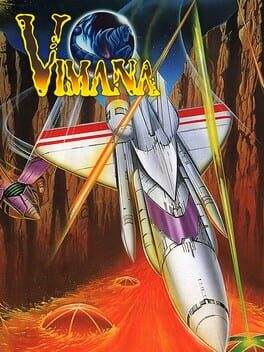
Arcade · Simulation · Tir · 1991
Vimana
Développé par Toaplan Édité par Clear River Games et Tecmo
Disponible sur
Présentation
Vimana is one of Toaplan's most unique shooters. The level design is particularly creative, along with a unique charge shot and bombs. It gets its name from the Sanskrit word for "Flying Machine", described in Sanskrit Epics. The storyline involves a planet being attacked by seemingly indestructible alien forces that induce fear and insanity to all that oppose them. The last hope for this planet is the Vimana Warriors, two ships that are empowered by the Hindu god Ganesha to defend against the aliens and restore peace to the galaxy.
The Vimana warriors are the player one and player two ships, each equipped with a shot that charges in the shape of a V. Once the shot is released, the V shape explodes forth in an arc, hitting almost everything in front of it. This sounds like it would be a very powerful weapon, but this leads to Vimana's main problem - none of your attacks ever do enough damage. Even the weakest enemies will take more than a few hits to destroy, even if your weapon is fully powered up. Bombs are similarly underwhelming, consisting of seven balls of light that rotate around your ship and guard you from shots. Once an enemy comes onto screen, a light ball will jump out from the group and crash into the enemy, likely destroying or heavily damaging it. Unlike in Fire Shark, where you can pick up new weapons, Vimana does not offer any weapons other than standard shots, charge shots, and bombs.
Vimana has some bits of creativity in its levels. One in particular has moving enemy searchlights, which will fire hard to dodge bullets if it spots you. An interesting boss fires from the bottom of the screen as opposed to the top. Vimana also attempts to squeeze around 50 enemy bullets on screen at once, making it feel like a sort of prototype bullet hell shooter.
Vimana was never ported to any home systems, but like Out Zone it would not have really fit onto any of them very well. The music was done by Toshiaki Tomizawa, who would later go on to make soundtracks for Fixeight, another Toaplan shooter and many of Cave's games, including Dodonpachi, Progear, Guwange, and ESP Ra. De..
Résumé en anglais, repris d’IGDB, en attendant une présentation en français. L’écrire
Durée de vie
Pas encore assez de temps de jeu : la durée de vie s’affiche à partir de 3 joueurs. Vous l’avez terminé ? Donnez le vôtre.
Sorties
| Plateforme | Date de sortie | Région | Statut |
|---|---|---|---|
| Arcade | Amérique du Nord | Sorti | |
| Japon | Sorti | ||
| Linux | Monde | Sorti | |
| Mac | Monde | Sorti | |
| PC (Microsoft Windows) | Monde | Sorti |
Accessibilité
Compléter (31 options inconnues)Vision
- Taille des textes réglable · inconnu
- Modes daltoniens · inconnu
- Contraste élevé · inconnu
- Menus lus à voix haute · inconnu
- Repères sonores pour se déplacer · inconnu
- Effets visuels atténuables (flashs, flou, secousses) · inconnu
- Champ de vision réglable · inconnu
Audition
- Sous-titres des dialogues · inconnu
- Sous-titres des sons (pour sourds et malentendants) · inconnu
- Taille et fond des sous-titres réglables · inconnu
- Nom de qui parle · inconnu
- Indicateurs visuels des sons · inconnu
- Volumes séparés (voix, musique, effets) · inconnu
- Son mono · inconnu
Motricité
- Remapping complet des commandes · inconnu
- Maintien remplaçable par un appui · inconnu
- Appuis répétés remplaçables · inconnu
- Jouable à une main · inconnu
- Sensibilité des commandes réglable · inconnu
- Aide à la visée · inconnu
- Vibrations désactivables · inconnu
- Séquences chronométrées évitables (QTE) · inconnu
Cognition
- Difficulté réglable · inconnu
- Rappel des objectifs · inconnu
- Tutoriels consultables à tout moment · inconnu
- Sauvegarde fréquente ou à tout moment · inconnu
- Pas de limite de temps · inconnu
- Pause à tout moment, cinématiques comprises · inconnu
- Aide à l’orientation (direction, carte) · inconnu
- Passages difficiles évitables · inconnu
- Rythme réglable (vitesse du jeu) · inconnu